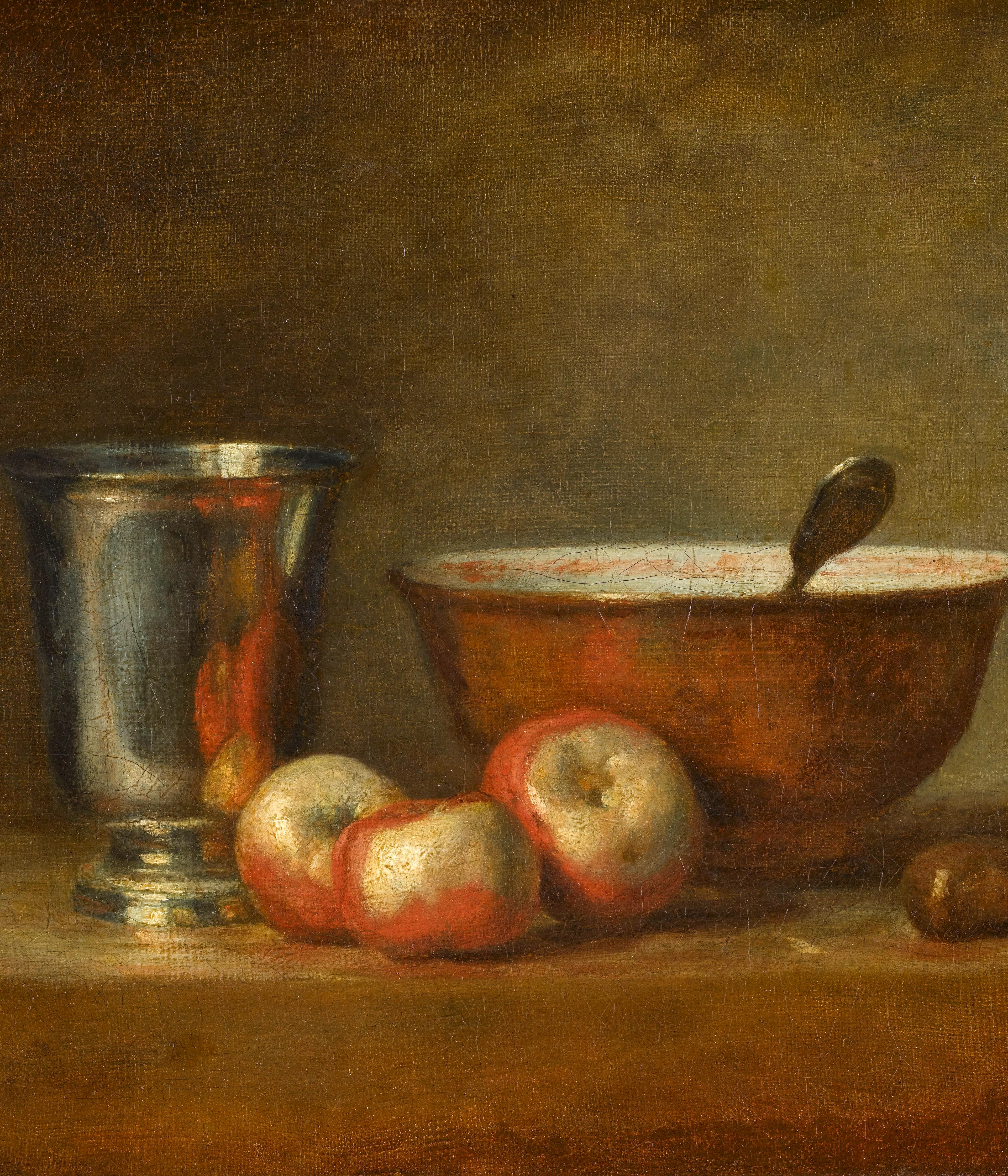
Jean Siméon Chardin
Jean Siméon Chardin (1699–1779) was a French painter who worked almost exclusively in the two genres the eighteenth-century Academy ranked lowest — still life and domestic scenes — and raised them to a level rarely equaled. Born in Paris, the son of a cabinetmaker, he spent his entire life in the same Left Bank quarter. In 1728 he was received into the Académie Royale de Peinture et de Sculpture as a painter "skilled in animals and fruits," presenting as his reception pieces The Ray and The Buffet, both now in the Louvre. Against the grand mythological and historical subjects prized in his day, Chardin built his art from humble objects and ordinary people.
His still lifes arrange kitchen vessels, fruit, game, and glass with a restraint that directs attention to surface, weight, and light rather than abundance. From the 1730s he extended this attention to genre scenes — Saying Grace, Soap Bubbles, Boy with a Top, Woman Sealing a Letter — quiet images of the Parisian bourgeoisie absorbed in small tasks, lit by a soft, even light and built up in a granular, deliberate handling of paint. Diderot was among his admirers; the artist is said to have maintained that one paints not with colors but with feeling. Late in life, as his eyesight failed, he turned to pastel, producing a series of self-portraits that count among his most searching works. He served the Academy for decades, as treasurer and as the official responsible for hanging the Salon.
Admired in his lifetime, Chardin was largely forgotten after his death as Neoclassicism took hold, and rediscovered only in the mid-nineteenth century by Realist critics such as Théophile Thoré and the Goncourt brothers. His influence runs through Manet, Cézanne, and Giorgio Morandi, and his work was the subject of some of Marcel Proust's early writing. Held today in the Louvre and major museums worldwide, he is regarded as one of the foremost painters of still life in European art.