
Introduction
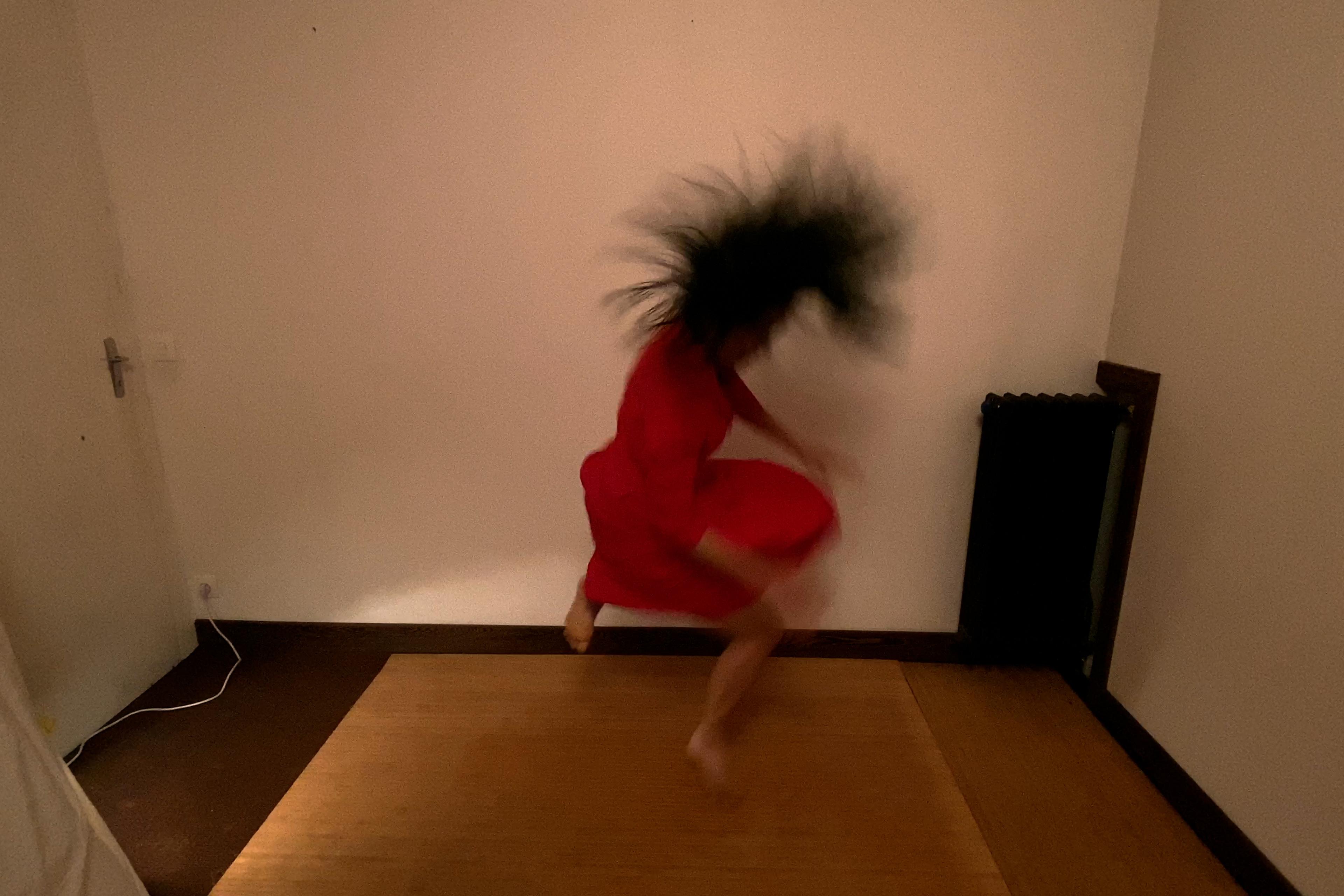
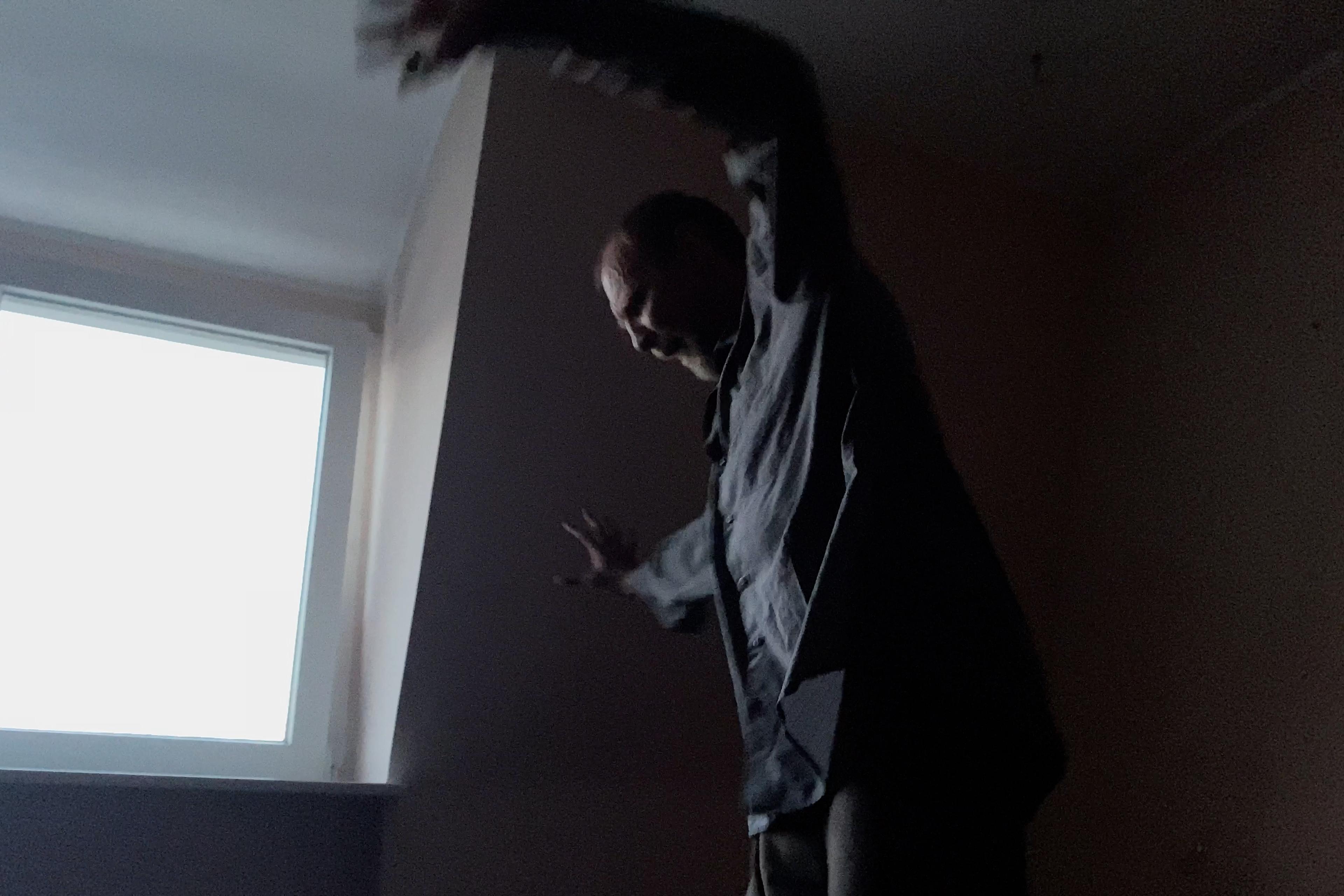
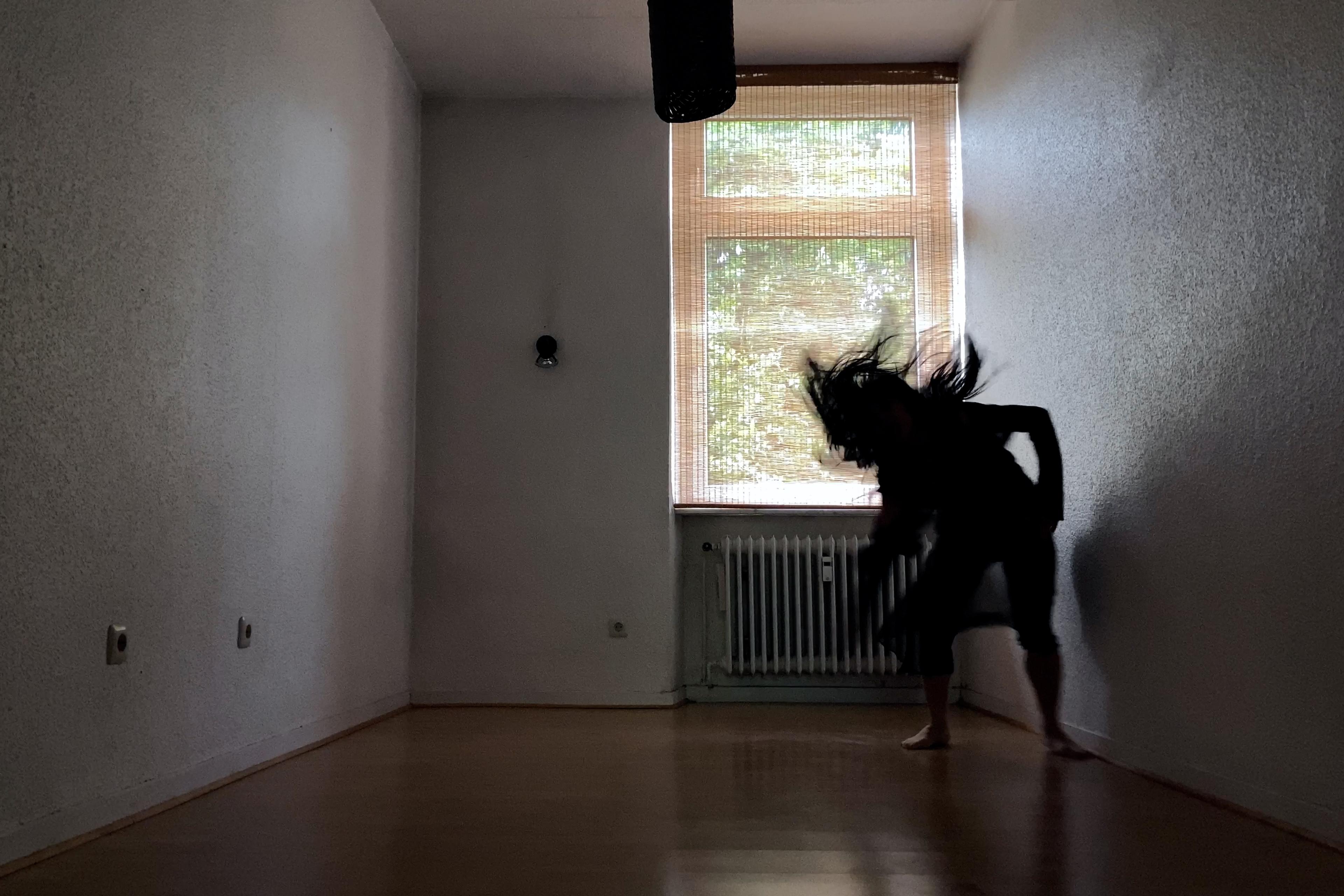
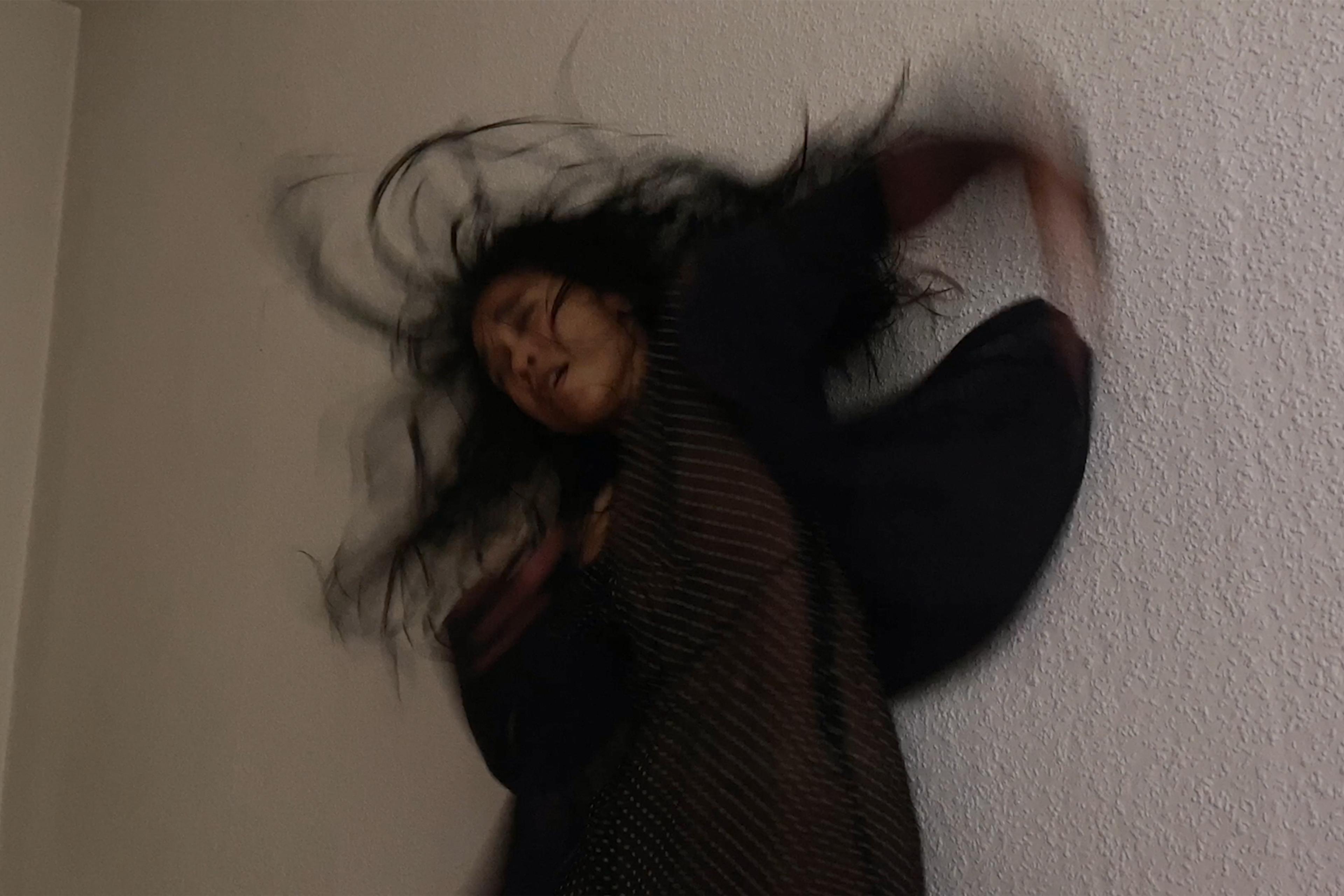
Silhouettes endlessly repeat the same gestures— tossing their hair, exhausting themselves, crashing into the bare walls of their cells. Gestures with no audience, gestures with no end. The sublime lamentations of Pina Bausch resonate here, transfigured by familiar faces from Tanztheater Wuppertal. Inspired by the dancing plague that struck the city of Strasbourg in 1518, Jonathan Glazer’s short film, shot in the middle of lockdown, captures the paranoia born of an invisible threat, and the life drive that takes hold of isolated bodies. In a fictional text freely inspired by the film—where words blur into the director’s images—writer Théo Casciani investigates. He listens for the faint signals of a sickened world and translates them into rhythm and resonance. What he seeks here is not an answer, but an intensity—the kind born from a dance on the edge of collapse, where repetition becomes a form of resistance, and perhaps, a language.
Théo Casciani
When I dance, I dance. Though I have never truly understood the meaning of this sentence, it simply has always clicked with me. Go figure, but from the moment I encountered it in a book (1), it lodged itself in my mind like a riddle to solve and a method for investigations. I’ve turned it upside down and downside up, I’ve dissected it, I’ve translated it, but it remains no less opaque. Still, whether you see me as a writer or a researcher, whether you place me in the field of science or in the field of imagination, not that it really matters because these ideas of fiction and reality no longer mean anything (2), well, this mystery, this particular sentence, I always keep it close at hand, and I tell myself that yes, certain things do not need clarification to be true. I think of joy, I think of grief, I think of love and I think of death; all things which needn’t be explained. These are my intentions. However, I must confess that this wish has often collided with foregone conclusions and equations without unknowns. Ever since the day I decided to use my personal tools to analyse my surroundings and until quite recently, occasions to settle genuinely intriguing problems or subjects that tickled my curiosity have been all too rare. Causes for concern, celebration or sentiment accumulated like platitudes. Loved ones would text me and ask whether I had heard about this or that anecdotic affair, and, to put it bluntly, I spent the better part of these years navigating from one banality to the next without realising I was simply bored out of my mind. But everything changed these last few weeks. I have finally found a question with no solution. I must now begin by saying that I’ve got no idea what’s happening. The current pandemic is way above my understanding. Since I’ve been hired to try and reveal the secrets of this phenomenon (3) which has brought the world to a standstill, since I’ve thrown myself wholeheartedly into this research (4), every day brings the same, solitary conclusion. I sense everything but can’t justify anything, I can feel it all but can’t express it. Which is why, as I am writing this report (5), honesty requires me to begin by disclosing this sentence, this mystery, this method, so that you are now aware of the only answer I can offer you. The fact seems obvious and its logic occult. The dancing plague keeps on spreading.
A voice draws me from my thoughts. I’m so used to images that only sound can catch my attention. I focus. It seems that the whisper is coming from the right-hand screen. There are nine screens in front of me. I check my notes and turn on the microphone to ask “HOW ARE YOU?.” I grab my notebook and begin the day’s categorisation by reciting: “CONTENT ONE. (6)” These carefully articulated syllables echo in a dimly-lit space, filmed from a diagonal angle, the edge of the walls opposite the lens cutting the scene into two nearly equal parts, shadows on one side and a pair of electrical sockets on the other. She doesn’t answer, but the patient immediately stands up and stumbles in my direction. She shrugs, rolls her eyes and resumes dancing. Her hips swing as she engages in a twisting motion, bends, flexes and stretches, her arms following every gesture without it being clear whether it’s her body or her hand leading the other, until she freezes in front of me and lets out a sinister, diabolical, delirious laugh, as if mocking the fool who thought for even an instant that she might have been cured. At this time, there have been nine confirmed deaths from the epidemic. The victims are from all around the world, from London to Dakar, from Tokyo to Berlin, through the plains of Oregon, Jakarta Bay and the outskirts of Dubai (7), hence no specific geographical criteria can be applied in the study. Digital manipulations have allowed us to sneak spyware into their electronic devices, including telephones, computers or alarms, in short anything with a camera, in order to install this surveillance system and watch the contaminated individuals. If technology has become a parasite (8), it is indeed a computer virus that exposes me everyday to this mosaic spread across four continents, always reaching the same verdict: people are dancing. The infection seems to be pushing patients to repeat the same action continuously, in a sort of perpetual time loop. In particular, this guy dressed in gray has been turning round and round since last Thursday, day in and day out, from dawn to dusk, never stopping, at times spreading out his chest to gain momentum, at others tightening his elbows for more abrupt movements; all the while, on the other side of my little laboratory, I see a woman in her thirties endlessly plunging her fingers into a bucket made of clear wood and filled with clear water, before groping her way along the walls of her apartment, as if blind or chased.
This detail isn’t without significance for those who take interest in the history of this illness (9). The first manifestation of the dancing plague dates from July 15, 1518, half a millenium ago, when a Strasbourg every-woman whom Paracelsus referred to as Frau Troffea (10) was spotted dancing near a river for days, after having thrown in it her child, which she was no longer able to feed (11). Dozens of other men and women quickly joined her and began dancing as well, right in the heart of the Alsatian capital. No remedy had proven effective; neither religious rituals to exorcise those believed to be caught in the grip of malignant conspiracies, nor forced exiles and pilgrimages to a cave dedicated to a saint supposedly able to cure this frenzy (12); neither the bleedings ultimately prescribed to relieve the victims filled with warm sap, nor the rationing of bread in the hopes of avoiding ergot poisoning, a syndrome caused by a fungus frequently found in rotten rye and suspected to induce hallucinations similar to the effects of LSD. With no better option, local authorities decided to install a stage on the grain market in front of the City Hall, and to hire musicians to encourage people to keep up their ballet until dehydration or exhaustion ensued (13). If they kept dancing, the evil would eventually leave their bodies. Centuries later, and despite new occurrences of similar phenomena, whether in Aachen, Metz, Erfurt, Madagascar (14) or even in Windmill Village, north on the map of Elden Ring (15), research has never been able to determine the origin of the sickness that experts to this day still call “chorea.” The most credible theory, or at least the most commonly discussed in literature on this form of hysteria, was put forth by historian Jon Waller (16). He disregarded all hypotheses previously stated by the scientific community, immediately pushing aside anything having to do with superstition, sorcery or astrology. He then expressed support for the idea according to which this scourge had its roots in the political and social context of the infected territories. The misery in which the people of Strasbourg were living had indeed provoked such sadness and despair that this trance would have been the only possible outlet to escape the unbearable stress inflicted by poverty. Dancing became a distress signal. I rip out my earphones and walk away from my screen, ignoring all my messages. The day is winding down.
A friend of mine suggested we spend the evening together for a change of air. I simply told her that going out dancing was not an option. I’ve been in Seoul for two weeks now. I had been invited here for a reading and I haven’t left yet. I just needed to be somewhere else. Because this plague stuff isn’t even the worst of it. My father died exactly a year ago. I remember the London rave, filled with boys, girls and people who were neither girls nor boys, the rave that I had left in a hurry when I got the call telling me to return to Paris at once. It was the end. The following hours are none of your business, although the time will come (17), but I can at least tell you that the last thing my father and I did together was to dance. I had held his right hand, I had wrapped my arm around his waist, and slowly, in the silent hospital, I had waltzed with what perhaps was already a corpse. As my taxi drives me to my meeting point, we cross an infinitely wide river. The car makes its way through the hills and the shining buildings, then deviates from its route to avoid a fascist demonstration (18). Contemplating the night brings me back to that other, year-old evening, as if both those skies, lit too brightly by urban radiations for the stars to be visible, were in fact connected across cosmic vastness, as if they had found each other through interstellar space to whisper into my ears these aching thoughts that haven’t left me alone, neither at the morgue nor with my patients: sometimes life escapes all discernible reason. We arrive in Itaewon. A couple of guys, clearly high, are crying their eyes out just as a lady removes her heels and licks a sandwich right off the ground. My friend is waiting for me in front of a nightclub surrounded by hundreds of onlookers and photographers. Once inside the lair, she takes a few seconds to explain that this establishment is popular with K-pop stars. Mute shadows are slumped on couches and in chairs all bathed in red light. Rhythms overlay and the volume is getting louder, but no music manages to get them to move. I feel good. I recognize a few familiar faces. Kazuha is applying makeup while Hyunjin is staring at his phone (19). I picture their days, replete with rehearsals, training and choreographies (20). It would seem they are too tired to dance.
I walked back to the hotel. It took me nearly an hour to reach the end of the long avenue lining the US military base (21). I waited for a more peaceful street to light a cigarette. I headed south, following a beacon in the sky, not knowing whether it was attached to a building or a mountain. My mind kept going back between the idols who could no longer bear to entertain the world and the victims who could no longer stop dancing. From one staircase to the next, I finally found the hotel room I had turned into a lab by loading it with screens and cables. No surprises: the situation hadn’t changed. Beyond time zones, no matter whether the sun had already risen or not yet set, the silhouettes persisted in their movement as if nothing else mattered. I believe I read somewhere that a country once banned its citizens from dancing in order to better suppress the illegal trades that the government associated with parties. If my memory serves me right, the ban was dependent on luminosity levels: grooving (22) was allowed as long as the place was lit like a theatre before the movie begins. It’s getting late now and I’m falling asleep. I’m falling asleep, and I’m observing a woman, seen from a long-angle shot, who insists on lifting her red dress over her underwear and stomach, her abdominal muscles contracting with every breath she takes. I’m falling asleep and I’m examining the comings and goings of a man with his back turned to the camera. I’m falling asleep, eyeing the patients whose attitudes I’ve surveyed all day, to compare them to those I’ve audited earlier. But little by little, my slumber is muddled by the feeling that something is happening. Muscles relax; bodies collapse. My surveillance apparatus has the advantage of using framing wide enough to easily detect the slightest variation in the image (23). As a teenager, I was fascinated with a music video, released not long after I was born, in which a singer attempts to keep his balance in a set with moving walls and animated furniture (24). In other words, what I’m seeing now is just about the exact opposite. The frame is motionless but the characters are moving. And though what I’m witnessing has as much to do with dementia as it does ecstasy, pain as it does pleasure, on closer inspection, all I can perceive is gravity and breath.
I sit up. I turn my computer back on and suddenly remember the messages I haven’t read yet. A notification informs me that a new thesis has just been published. A joint study from the epidemiology departments of Oxford and Taiwan Universities confirms that, according to tracking with the cooperation of international police forces, the victims are indeed isolated and there has been no direct contact between them. However, it then stipulates that they might have encountered and influenced each other online (25). In other words, it is by seeing others dance that one becomes exposed to contagion. Orders are for any individual with access to these images to remain confined and give up any social interaction, whether physical or digital, under penalty of law. My first reflex is to contact the friend I just spent the evening with. But I reconsider just as quickly as my imagination envisions the potential consequences: I’d rather avoid placing all of Korean show business under quarantine and turn the entire world into contact cases. I wander on forums dedicated to the scientific community, asking myself why the platforms for technophiles are always the ugliest. I start reading a series of comments praising the study as a significant leap forward. Some simply take note of this precautionary principle while others, more ingenious, are speculating on whether using temporary VPNs might contain the phenomenon (26). Too late, the authors of the study reply. We should know more in a couple of days, but the victims seem to have already departed, as if they needed to be somewhere else. Each step carries them further into a parallel universe, a sort of alternate reality; a simulation (27). I get up to go pee, staring at my tired reflection in the mirror. I gauge my distorted features, my swollen cheekbones, chapped lips, bushy moustache, my temples dotted with sparse hairs and my smooth neck, then my gaze, absent, unsoft and unkind in every way, nearly mean, mirrored dilated pupils riveted to mine, defying me, full of menace. Now that I’m kept at bay, I realize how alone I am. I brought with me an old copy of The Savage Detectives (28), my notebook and a magazine I don’t understand a word of. I’ve had enough of screens. I hear a distant K-pop melody coming from outside. Through the window, I spy a child dancing in front of his phone, in the middle of an empty street.
I try getting back to my investigation, but I’m hit by a sudden panic attack. I repress the first spasm. I feel like I’m going to vomit. The woman in red keeps lifting up her dress. Another is hitting her head with all her might. I’m scared. A silhouette is caught in a struggle against her wall. Her eyes are white. The hair of the woman who was wetting her hands is now soaked. A shiver runs up my spine and dissolves in my neck. The sound of breathing blends with the laughs and shouts. Maybe I’m going crazy, but I begin tapping to the rhythm. A high-frequency beat to a repetitive and jerky music, somewhere around 170 bpm (29). My heartbeat rises to match the tempo. I feel my breath racing. A second spasm raises my chest and carries an acid spurt to my throat. I lay down. A patient has sat down and started twirling his arms around his shoulders and elbows. I freeze, noticing that someone is lurking in the hallway and getting dangerously close to my room. I turn around and bite my tongue, trying to remain silent. A few seconds pass. Nothing to fear, it looks like they have left. Almost against my will, to my great despair in any case, my eyes return to the ailing. One of them whispers “EVERY MORNING” (30) and bursts into laughter at my incomprehension. None of the patients have their backs turned to the camera. I don’t know where I’m at. My temples are hot. The melody is sometimes laden with piercing sounds, like those of a moaning animal or a drifting car. A dancer shakes her fingers, to ward off evil spirits. Her face expresses terror or orgasm. She seems possessed. An email threatens to leak my pornographic history if I don’t send a considerable sum of bitcoins as soon as possible. The guy in gray gets back on his feet after having fallen down, proceeds to imitate a juggler and resumes whirling around. He looks like my father. It’s been a year. A body, huffing and puffing, trying to grasp something invisible. The small skylight gives onto a rainy sky. The room is empty (31). Both his, and hers; both here, and there. I’m thirsty and warm. Multiple punches hit the camera. Clothing is put on, then taken off, then put back on again. Some clap, some scream. The walls are coated in blood. My head is spinning. I can’t stand it anymore, this avalanche of gestures, I can’t stand staring at these moving images (32). The first rays of dawn break over the horizon. This is a nightmare. It’s probably time to sleep.
My friend just tried to call me. I rub my eyes and realize I drooled on myself. She’s tried to call me six times. I reach for my phone to check if she’s ok. Like every morning, it’s noon already. I can’t get up, I let a few minutes of innocence float around, and then read that a curfew has been imposed in Seoul following the discovery of chorea symptoms in hundreds of residents. The infection cluster is located in the Itaewon neighborhood. My throat tightens. My friends ask if I have any more information. I hesitate, but decide to lie. It is what I do best. The World Health Organisation has just expressed the utmost concern after observing that many of the intoxicated people are famous, so famous that they have a following and are thus dangerous. All networks are cut. It’s done: humanity is now cut off from the world. Since I know of no better antidote to disarray than work, I decide to focus on my patients, before I get a few thousand more to keep an eye on. I zoom in on the pixels, trying to make out their variations. A man is hopping around in the dark, but the feed seems more and more glitchy. The monitor twitches, then cuts off. I fiddle with some outlets just to make sure everything is plugged in correctly, I restart all the devices, I track down the origin of the bug and double check the process, but despite it all, there’s nothing I can do, it seems the connection has been totally lost. Faced with this agonising laboratory, I start trembling. I mistake my own reflection for a new movement, and what suddenly comes to my mind isn’t just related the epidemic or the research, nor to my father or my friend, no, it’s the intuitive link between all these things which now occupies my thoughts: it is now evident that what these events remind me of are danses macabres. Although this folklore emerged from the wars and plagues of the Middle Ages to illustrate the universality of death by having skeletons dance together, skeletons from all ranks of society, clergymen, kings and beggars, memento mori of the genre, dear to Baudelaire and Liszt, endured throughout fads and quite naturally inspired the aesthetics of the first horror films. As I face the dark screens, trying to regain my composure, my body contracts, relaxes, and as I recall all the shapes I have seen dancing in this patchwork, at the moment I remember that these victims are indeed real, I tell myself that fear needs no characters and that this is how the world is, indeed, once and for all: macabre.
I don’t know what to do; there is nothing to do. I guess they’ll come arrest me soon. Although it’s getting more difficult to control my muscle spasms, I manage to get a hold of my notebook and open it, wasting no time on the information contradicted by the recent development. As I flip through past obsolete or indecipherable sketches, I finally come across the image that the group’s coordination centre entrusted us with at the start of the probe. As is often the case for such important missions, all investigative teams received an indestructible archive, so that even in the event of confinement, removal or network malfunction, a trace, a reference point in case of emergency, would always remain. My gaze wanders beneath the rows of printed words, losing itself in the shimmer of pixels vibrating in the background, calling to mind in turn a drove of scattered grains, a swarm of voracious insects, and a shower of shooting stars, or else just bacteria, fertile, aggressive germs, a virus spreading across the page. I stroke the paper and begin to shake it in front of my eyes. The picture wiggles between my fingers. Convulsions prevent me from holding it as tightly as I’d want to, but the most important thing from now on is not what the image represents, a woman tumbling down and getting back up whether one tilts the image from left to right or right to left, but indeed the simple act she’s engaged in: dancing. My chest arches, throws my shoulders back against my will, my neck tilts along to the mechanical oscillation of my shoulder blades, which I can feel cracking under the skin. I clench my fists like a drugged-out raver or a fighter ready for action. My eyes are closed but I’m still aware of where my phone and computer are positioned. I know exactly how I will be filmed, and it amuses me. I let myself go. When I dance, I dance. Despite the pain, despite the sweat, I keep beating the pulse, eight bars at 170 bpm again and again and again. It’s been a year since I last experienced this. For a whole year I’ve waited to be reunited with my father and tell him I miss him. That guy really looks just like my father. Words come out of my mouth; “EVERY MORNING.” I can’t help it. My arm carries my wrist and my hips guides my stomach, my back obeys my thighs and my chin follows my arm. I sense a presence, or many, around me. I join them. We are a crowd, silhouettes embracing the same trajectory, and I know that we are finally together, held and held down by the rhythm merging us. If we dance, it’s that the world is standing still.
Footnotes
(1) Michel de Montaigne, “De l’expérience,” Chapter 13, Book III of Essais (La Pléiade, 1962).
(2) Michel de Montaigne, “De l’expérience,” Chapter 13, Book III of Essais (La Pléiade, 1962).
(3) Jonathan Glazer's him Strasbourg 1318 (BBC Arts, Artangel and Sadler's Wells, 2020) inspired by the dancing plagues of the Middle Age
(4) This text was written during the COVID-19 pandemic.
(5) This text has been translated by Gabriel René Franjou and written with the assistance of Alice Butterlin.
(6) The soundtrack repeats a sample of the same voice multiple times throughout the film.
(7) The performers are Germaine Acogny, Andrey Berezin, Kaori Ito, Ditta Miranda Jasjfi, Jamila Johnson-Small, Nazareth Panadero, Botis Seva, Oleg Stepanov and Tsai-Chin Yu.
(8) Jeffrey Robbins, "If Technology Is a Parasite, Are We the Host?" in Technology and Society (2019).
(9) Justus Hecker, The Black Death and The Dancing Mania (Cassell, Petter and Galpin, 1888).
(10) Paracelsus, Opus Paramirum (J.A. Barth, 1922).
(11) The Pont du Corbeau [Raven's Bridge], in Strasbourg, overlooks an arm of the Ill, which flows into the Rhine.
(12) Madeleine Braekmen, "La dansomanie : hérésie ou maladie ?" Revue du Nord 13 (1981).1518 - La fièvre de la danse (Éditions des Musées de Strasbourg, 2018).
(14) Aristide Auguste Stanislas Verneau, "Sur les chorées épidémiques de Madagascar, d'Italie et d'Abyssinie," Bulletin de la Société d'Anthropologie de Paris (1865).
(15) Hidetaka Miyazaki and George R. R. Martin, Elden Ring (FromSoftware, 2022).
(16) Jon Waller, The Dancing Plague (Sourcebooks, 2009).
(17) Théo Casciani, Insula (Éditions P.O.L, 2026).
(18) In December 2024, South Korean president Yoon Suk Yeol attempted to establish martial law, in vain.
(19) Kazuha is a member of the band Le Sserafim, Hyunjin is one of the rappers from Stray Kids
(20) Komeil Soheili, "Grueling gym routines, restrictive diets, and no dating: K-pop stars tell us about the dark side of their industry," Business Insider (2019).
(21) In 1952, the United States Armed Forces established a military base in the Yongsan district, previously under control of the Imperial Japanese Army.
(22) In 1948, Japan passed a law prohibiting dancing in establishments without a specific license, in an effort to stop the rise of sex work.
(23) For the cinematography of Strasbourg 1518, Darius Khondji worked with images captured on iPhones 11 Pro sent to the performers.
(24) 24 Jonathan Glazer, Virtual Insanity, music video for Jamiroquai (1996).
(25) Herbert Kelman, "Compliance, identification, internalization."
Journal of Conflict Resolution (1958).
(26) A Virtual Private Network is a service making it possible to modify an IP address through tunneling and encryption.
(27) Octavia E. Butler, Dawn (Warner Books, 1987).
(28) Roberto Bolaño, 1998, The Savage Detectives, English translation by Natasha Wimmer.
(29) The soundtrack of Strasbourg 1518 was composed by Mica Levi
(30) The soundtrack repeats a sample of the same voice multiple times throughout the film.
(31) The movie was shot by the performers, confined in their apartments
(32) The editing, by Paul Watts, consists of as many shots as sentences in this text and follows the same crescendo dynamic.
Credits
Jonathan Glazer, STRASBOURG 1518, Film Still, 2020
©2020 Jonathan Glazer and Artangel
Courtesy of Jonathan Glazer and Artangel
Théo Casciani, “MACABRE,” 2025
©2025 Théo Casciani
English translation by Gabriel René Franjou