
Introduction
At the age of eighty, Jean-Luc Godard made a radical decision—true to the spirit of his work and his life. He sorted, catalogued, and packed a lifetime of work and memory into boxes: films, manuscripts, reels, tapes, books, annotated pages, fragments of images and ideas. Whether a testament or an act of creation, this stripping-away marked not an ending but an extreme form of lucidity: reclaiming his own chaos, and putting it in order before vanishing. In Rolle, at the filmmaker’s home, Stephan Crasneanscki bore witness to this silent undertaking, photographing the contents of the boxes. The following pages present a selection from these archives. They are accompanied by a souvenir written by Patti Smith—who was once filmed by Godard—and a conversation with Stephan Crasneanscki.
Patti Smith
True masters do not declare themselves. It is their acolytes, chosen or self-willed, who bestow such praise upon one such as Jean-Luc Godard. And what are the elements of our adopted master? A meld of contradictions: obstinate shyness, a cagey sense of humor, a silent sense of self-worth and a deep sense of the worth of others. His knowledgeable shears have cut, rearranged, and assembled the stained glass of life, a body of work unfettered, yet not devoid of moral and political energy.
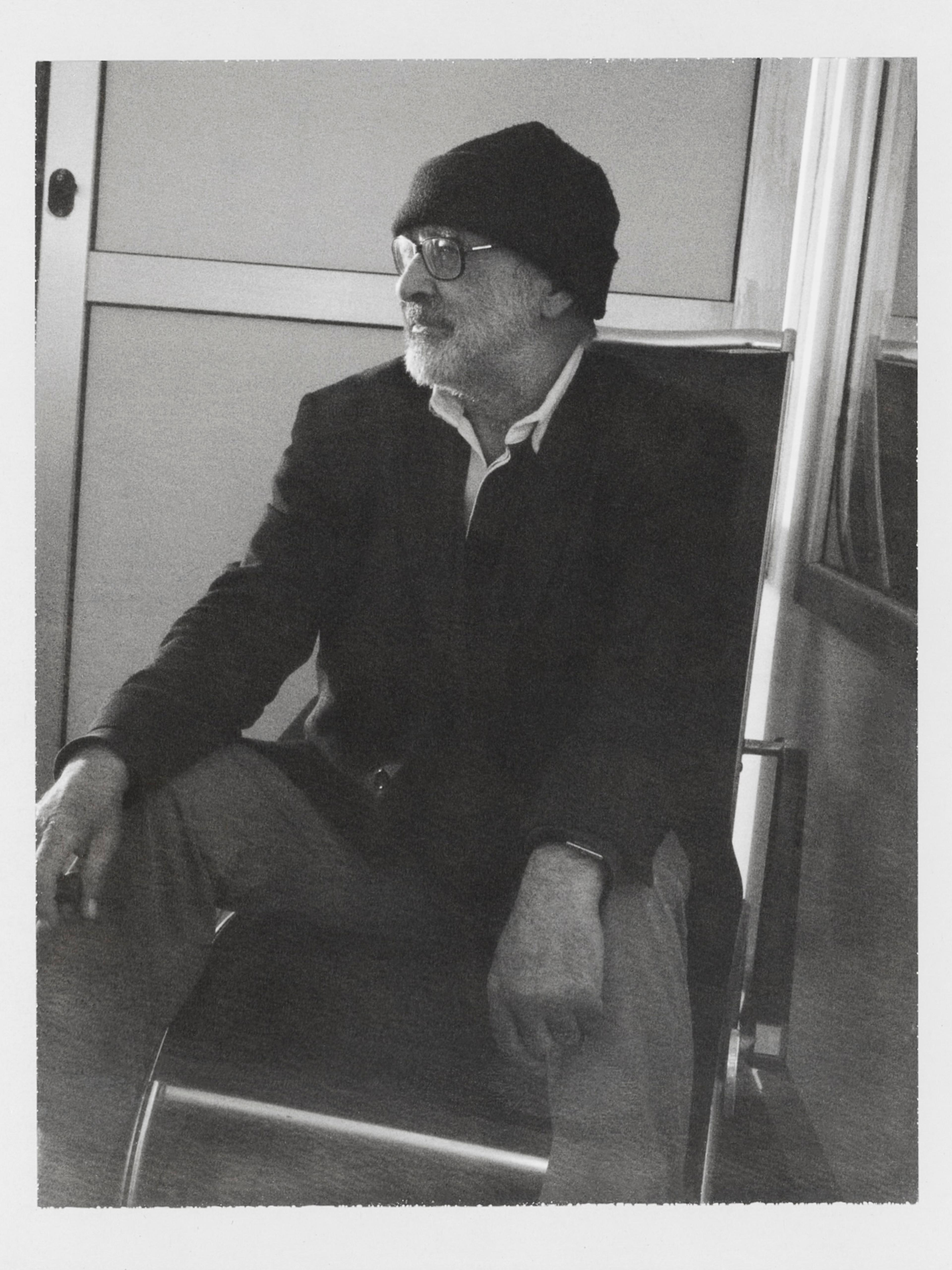
He is mercurial, hard to pin down, yet can light up ten levels of an Italian cruise ship with his fleeting mischievous smile. I have seen that smile as he shot on the bridge of the ill-fated Costa Concordia, anchored in the Port of Alexandria. A group of us had gathered in this unlikely place for the filming of Film socialisme. That same smile can be traced back in time, into the center of the twentieth century as he drifted in and out of brutally beautiful moments in film. We see him in Jacques Rivette’s Paris nous appartient, and again in Rohmer’s La sonate à Kreutzer in his dark raincoat and dark glasses. Through decades always dark glasses, the emblem of an age, even as he examines a strip of film. There is an obscure photograph of him lighting a cigarette for Marguerite Duras. These images can be found in an archive of love, for a man I have hardly known. Yet I waited endlessly for him to call for me on that ship, sang a lullaby through his lens, snapped a Polaroid of him with his permission, and later found my own face among his discarded possessions.
When he was eighty he packed everything in boxes. He cast off a life of research, precious papers, references, talismans, shards of existence. And these boxes, what would become of them? Burned in a field as witches were burned? Stored away in a government warehouse with the remains of saints and aliens? Or, as in his Weekend, found in a future scrapheap, dangling in the vortex of time? Mystical archives, from the time of Alexander to the vaults of the Vatican to the Archive of the League in Journey to the East. Archives in meticulous order, or lost in crumbling dust. And this, the archive of a man whose love of the language of cinema has magnified our comprehension of this fragmented world. It is a generous glimpse, not of a completed work, but the unfolding mind. The archive of memory, of evidences of the Crime of Art. The once hidden secret miraculous process of Jean-Luc Godard, the reluctant Master.
New York City, 2021
Credits
Patti Smith, The Reluctant Master, 2021
Copyright 2021 Patti Smith
In Stephan Crasneanscki, What We Leave Behind, 2021
Courtesy of Libraryman