
Introduction
One summer afternoon, in his studio in Arles, François Halard recalled a text by Goethe about Villa Palagonia. Breton and Dalí shared the great Romantic poet’s fascination for the baroque ugliness of this Sicilian palace, filled with monsters and deformed figures. These photographs are published for the first time.
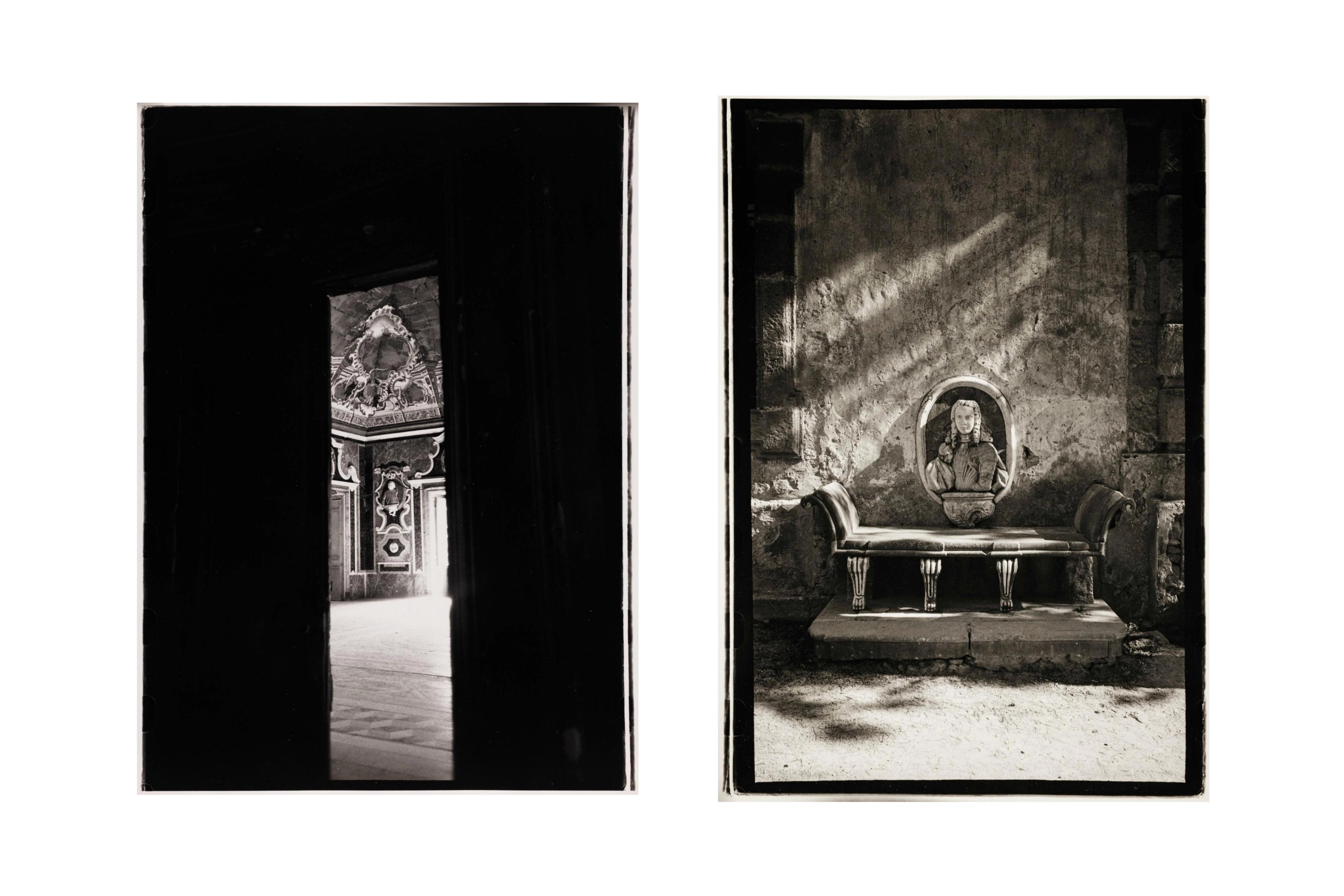
Johann Wolfgang von Goethe
Palermo
Monday, April 9, 1787
This whole day has been taken up with the stupidities of the Prince Palagonia, whose follies are thoroughly different from what one would form an idea of either by reading or by hearing of them. For, with the slightest love of truth, he who wishes to furnish an account of the absurdgets into a dilemma: he is anxious to give an idea of it and so makes it something, whereas, in reality, it is a nothing which seeks to pass for something. And here I must premise another general reflection; viz., that neither the most tasteless nor the most excellent production comes entirely and immediately from a single individual or a single age, but that with a little attention anyone may trace its pedigree and descent.
The fountain already described in Palermo belongs to the forefathers of the Palagonian follies, only that the latter, in their own soil and domain, develop themselves with the greatest freedom and on the largest scale.
When in these parts a country-seat is built, it is usually placed in the middle of a whole property: and therefore, in order to reach the princely mansion, you have to pass through cultivated fields, kitchen-gardens, and similar rural conveniences; for these Southerns show far more of economy than we Northmen, who often waste a good piece of rich land on a park, which, with its barren shrubs, can only charm the eye. But here it is the fashion to build two walls, between which you pass to the castle, without knowing in the least what is on your right and left. This passage begins generally with a grand portico, and sometimes with a vaulted hall, and ends with the mansion itself. But, in order that the eye may not be entirely without relief between these by-walls, they are generally arched over, and ornamented with scrolls, and also with pedestals, on which, here and there, a vase is placed. The flat surfaces are plastered, divided into compartments, and painted. The court is formed by a circle of one-storied cabins, in which work-people of all sorts reside, while the quadrangular castle towers over all.
This is the sort of building which is here traditionally adopted, and which probably was the old form, when the father of the present prince rebuilt the castle, not in the best, but still in tolerable taste. But the present possessor, without abandoning the general features of this style, gave free course to his humour and passion for the most ill-shapen and tasteless of erections. One would do him too much honour by giving him credit for even one spark of taste.
We entered, therefore, the great hall, which stands at the beginning of the property, and found ourselves in an octagonal room, of a breadth altogether disproportioned to its height. Four vast giants with modern spatterdashes, which had just been buttoned on, support the cornice, on which, directly meeting the eye as you enter, is a representation of the Holy Trinity.
The passage to the castle is broader than usual, the wall being converted into one continuous high socle; from this basement the strangest groups possible reach to the top, while in the spaces between them several vases are placed. The ugliness of these unshapely figures (the bungling work of the most ordinary mason) is increased by their having been cut out of a very crumbly muscheltufa; although, perhaps, a better material would have made the badness of the form still more striking to the eye. I used the word “groups” a moment ago; but I have employed a wrong term, inappropriate in this place. For they are mere juxtapositions, determined by no thought, but by mere arbitrary caprice. In each case, three form the ornament of a square pedestal, their bases being so arranged as to fill up the space by their various postures. The principal groups have generally two figures, which occupy the chief face of the pedestal, and then two are yet wanting to fill up the back part of the pedestal. One of a moderate size generally represents a shepherd or shepherdess, a cavalier or a lady, a dancing ape or a hound. Still there is a vacant spot on the pedestal: this is generally held by a dwarf, — as, indeed, in dull jokes, this sort of gentry usually play a conspicuous part. That we may not omit any of the elements of Prince Palagoniaʼs folly, we give you the accompanying catalogue. Men: beggars, male and female, Spanish men and women, Moors, Turks, hunchbacks, cripples of all sorts, strolling musicians, pulcinellos, soldiers in ancient uniforms, gods, goddesses, gentlemen in old French costumes, soldiers with cartouche boxes and gaiters, mythological personages (with most ridiculous companions, — Achilles and Charon, for instance, with Punch). Animals (merely parts of them): heads of horses on human bodies, misshapen apes, lots of dragons and serpents, all sorts of feet under figures of all kinds, double-headed monsters, and creatures with heads that do not belong to them. Vases: all sorts of monsters and scrolls, which below end in the hollows and bases of vases.
Just let any one think of such figures furnished by wholesale, produced without thought or sense, and arranged without choice or purpose, — only let him conceive to himself this socle, these pedestals and unshapely objects in an endless series, and he will be able to sympathise with the disagreeable feeling which must seize every one whose miserable fate condemns him to run the gauntlet of such absurdities.
We now approach the castle, and are received into a semicircular forecourt. The chief wall before us, through which is the entrance-door, is in the castle style. Here we find an Egyptian figure built into the wall, a fountain without water, a monument, vases stuck around in no sort of order, statues designedly laid on their noses. Next we came to the castle court, and found the usual round area, enclosed with little cottages, distorted into small semicircles, in order, forsooth, that there might be no want of variety.
The ground is, for the most part, overgrown with grass. Here, as in the neighbourhood of a church in ruins, are marble urns with strange scrolls and foliations, collected by his father; dwarfs and other abortions of the later epoch, for which, as yet, fitting places have not been found; one even comes upon an arbour, propped up with ancient vases, and stone scrolls of various shapes.
The absurdities produced by such want of judgment and taste, however, are strikingly instanced by the fact that the windowsills in these cottages are, without exception, oblique, and lean to one side or the other, so as to offend and violate all sense of the level and perpendicular, which are so indispensable in the human mind, and form the foundation of all architectural propriety. And then, again, the edges of all the roofs are embellished with hydras and little busts, with choirs of monkeys playing music, and similar conceits. Dragons alternate with deities; an Atlas, who sustains not the mundane sphere, but an empty wine-barrel!
One hopes to escape from all this by entering the castle, which, having been built by the father, presents relatively a more rational appearance when viewed from the exterior. But in vain; for at no great distance from the door one stumbles upon the laurel-crowned head of a Roman emperor on the body of a dwarf, who is sitting astride a dolphin.
Now, in the castle itself, of which the exterior gives hope of at least a tolerable interior, the madness of the prince begins again to rave. Many of the seats have lost their legs, so that no one can sit upon them; and if some appear to promise a resting-place, the chamberlain warns you against them, as having sharp prickles beneath their satin-covered cushions. In all the corners are candelabras of porcelain china, which, on a nearer view, you discover to be cemented together out of different bowls, cups, saucers, etc. Not a corner but some whim peeps out of it. Even the unequalled prospect over the promontory into the sea is spoiled by coloured glass, which, by its false lights, gives either a cold or a fiery tint to the neighbouring scenes. I must also mention a cabinet, which is inlaid with old gold frames, cut in pieces. All the hundredfold carvings, all the endless varieties of ancient and modern, more or less dust-stained and time-injured, gilding, closely huddled together, cover all the walls, and give you the idea of a miniature lumber-room.
To describe the chapel alone would require a volume. Here one finds the solution of the whole folly, which could never have reached such a pitch in any but a bigoted mind. How many monstrous creations of a false and misled devotion are here to be found, I must leave you to guess for yourself. However, I cannot refrain from mentioning the most outrageous: a carved crucifix is fastened flat to the roof, painted after nature, lackered and gilded; into the navel of the figure attached to the cross, a hook is screwed, and from the latter hangs a chain which is fastened to the head of a man who, in a kneeling and praying posture, is suspended in the air, and, like all the other figures in the church, is painted and lackered. In all probability it is intended to serve as a type of the ownerʼs unceasing devotion.
Moreover, the house is not finished within. A hall built by the father, and intended to be decorated with rich and varied ornaments, but not tricked out in a false and offensive taste, is still incomplete; so that, it would seem, even the boundless madness of the possessor is at a standstill.
Kniepʼs artistic feeling was almost driven to desperation in this madhouse; and, for the first time in my life, I found him quite impatient. He hurried me away, when I wished to take a note of, and to perpetuate the memory of, these monstrous absurdities, one by one. Good-naturedly enough, he at last took a sketch of one of these compositions, which did, at least, form a kind of group. It represents a woman with a horseʼs head, sitting on a stool, and playing at cards with a cavalier, dressed, as to his lower extremities, in the old fashion, while his gray head is ornamented with a large wig and a crown. The statue reminded me of the arms of the house of Palagonia, — a satyr, holding up a mirror before a woman with a horseʼs head, which, even after all the strange follies of its present head, seems to me highly singular.
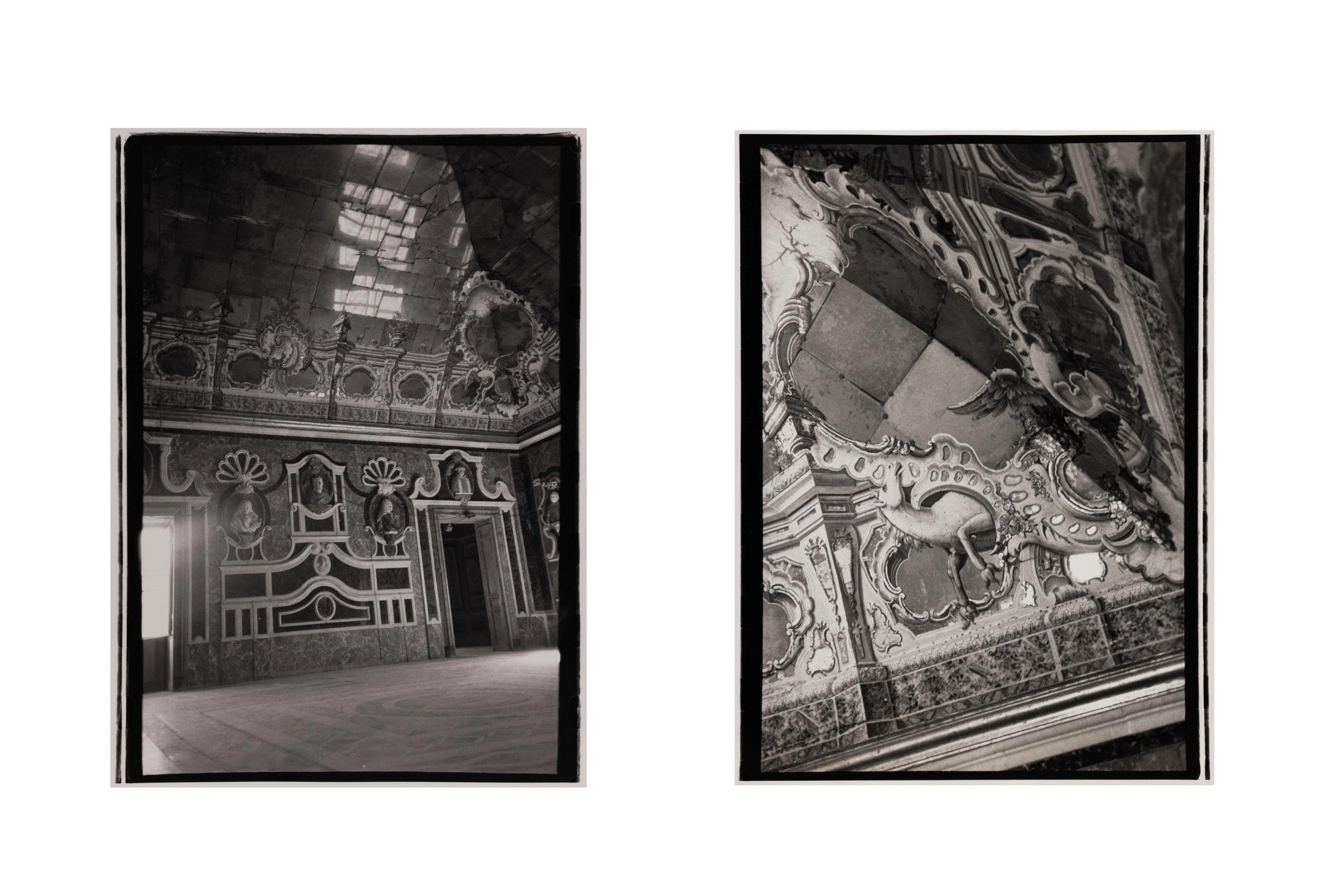
Palermo
Tuesday, April 10, 1787
Today we took a drive up the mountains to Mon Reale, along a glorious road which was laid down by an abbot of this cloister in the times of its opulence and wealth, — broad, of easy ascent; trees here and there; springs,
and dripping wells, decked out with ornaments and scrolls somewhat Palagonian in style, but still, in spite of all that, refreshing to both man and beast.
The monastery of St. Martin, which lies on the height, is a respectable building. One bachelor alone, as we see in the case of Prince Palagonia, has seldom produced anything rational; but several together, on the other hand, have effected the greatest works, such as churches and monasteries. But perhaps these spiritual fraternities produced so much, simply because, more than any father of a family, they could reckon with certainty on a numerous posterity.
The monks readily permitted us to view their collection of antiques and natural objects. They contained many excellent specimens of both. Our attention was particularly fixed by a medallion, with the figure of a young goddess, which must excite the rapture of every beholder. The good monks would willingly have given us a copy, but there was nothing within reach which would do to make a mould.
After they had exhibited to us all their treasures, — not without entering on an unfavourable comparison of their present with their former condition, — they led us into a small but pleasant room, from the balcony of which one enjoyed a lovely prospect. Here covers were laid for us alone, and we had a very excellent dinner to ourselves. When the dessert was served, the abbot and the senior monks entered, and took their seats. They remained nearly half an hour, during which time we had to answer many questions. We took a most friendly farewell of them. The younger brethren accompanied us once more to the rooms where the collections were kept, and at last to our carriage.
We drove home with feelings very different from those of yesterday. Today we had to regret a noble institution which was falling with time; while, on the other hand, a most tasteless undertaking had a constant supply of wealth for its support.
The road to St. Martin ascends a hill of the earlier limestone formation. The rock is quarried and broken, and burnt into lime, which is very white. For burning the stone, they make use of a long, coarse sort of grass, which is dried in bundles. Here, too, it is that the calorex is produced. Even on the most precipitous heights is a red clay, of alluvial origin, which serves the purposes of our dam-earth. The higher it lies the redder it is, and is but little blackened by vegetation. I saw, at a distance, a ravine almost like cinnabar.
The monastery stands in the middle of the limestone hill, which is very rich in springs.
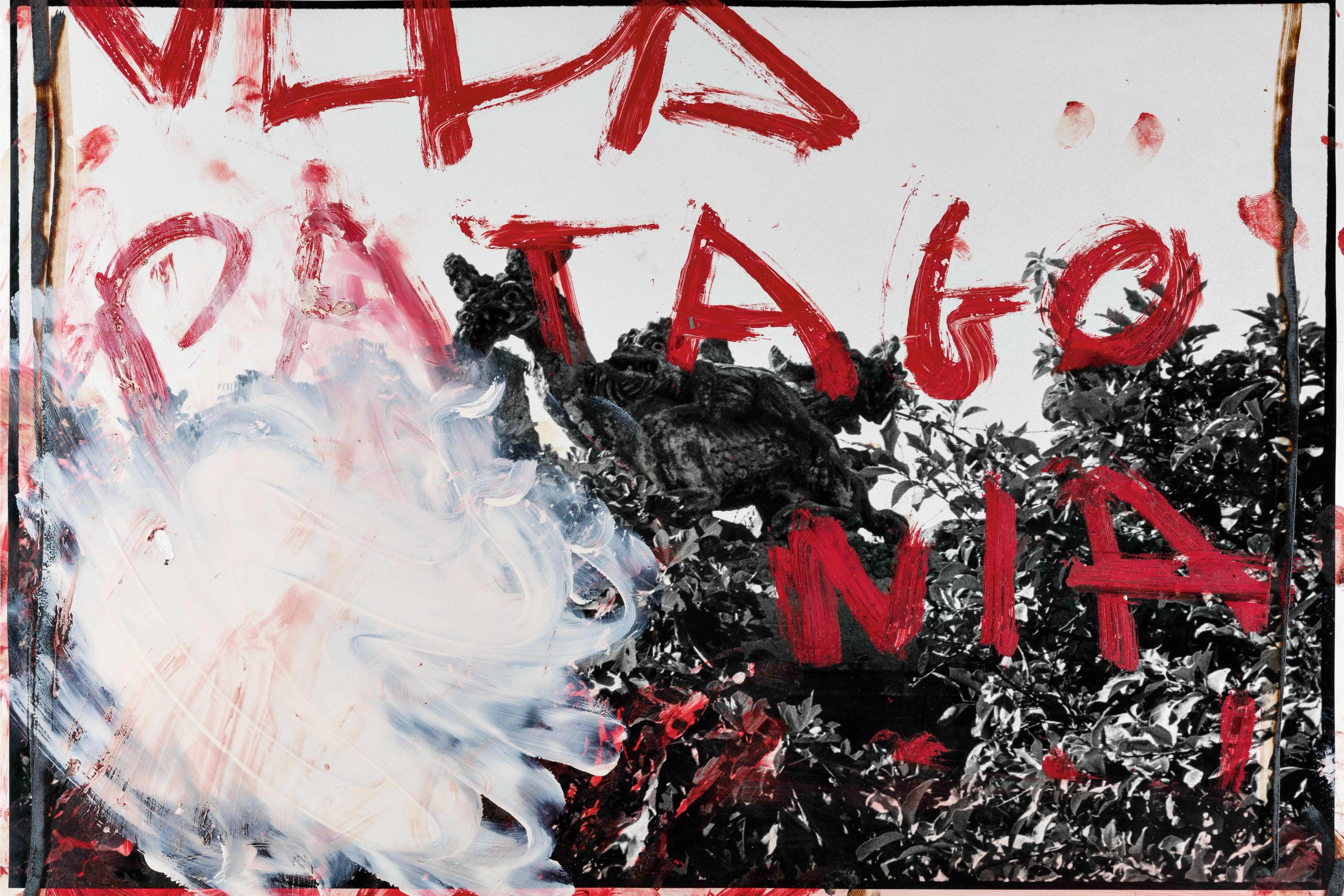
Palermo
Wednesday, April 11, 1787
Having explored the two principal objects without the city, we betook ourselves to the palace, where a busy courier showed us the rooms and their contents. To our great horror, the room in which the antiques are generally placed was in the greatest disorder, in consequence of the walls being in the process of decoration. The statues were removed from their usual places, covered with cloth, and protected by wooden frames; so that in spite of the good will of our guide, and some trouble on the part of the work-people, we could only gain a very imperfect idea of them. My attention was chiefly occupied with two rams in bronze, which, notwithstanding the unfavourable circumstances, highly delighted our artistic taste. They are represented in a recumbent posture, with one foot stretched out before them, with the heads (in order to form a pair) turned on different sides. Powerful forms, belonging to the mythological family, and well worthy to carry Phrixus and Helle. The wool, not short and crisp, but long and flowing, with a slight wave, and shape most true to nature, and extremely elegant: they evidently belonged to the best period of Grecian art. They are said to have stood originally in the harbour of Syracuse.
The courier now took us out of the city to the catacombs, which, laid out on a regular architectural plan, are anything but quarries converted into burial-places. In a rock of tufa, of tolerable hardness, the side of which has been worked level and perpendicular, vaulted openings have been cut; and in these, again, are hewn several tiers of sarcophagi, one above the other, all of the natural material, without masonry of any kind. The upper tiers are smaller, and in the spaces over the pillars are tombs for children.
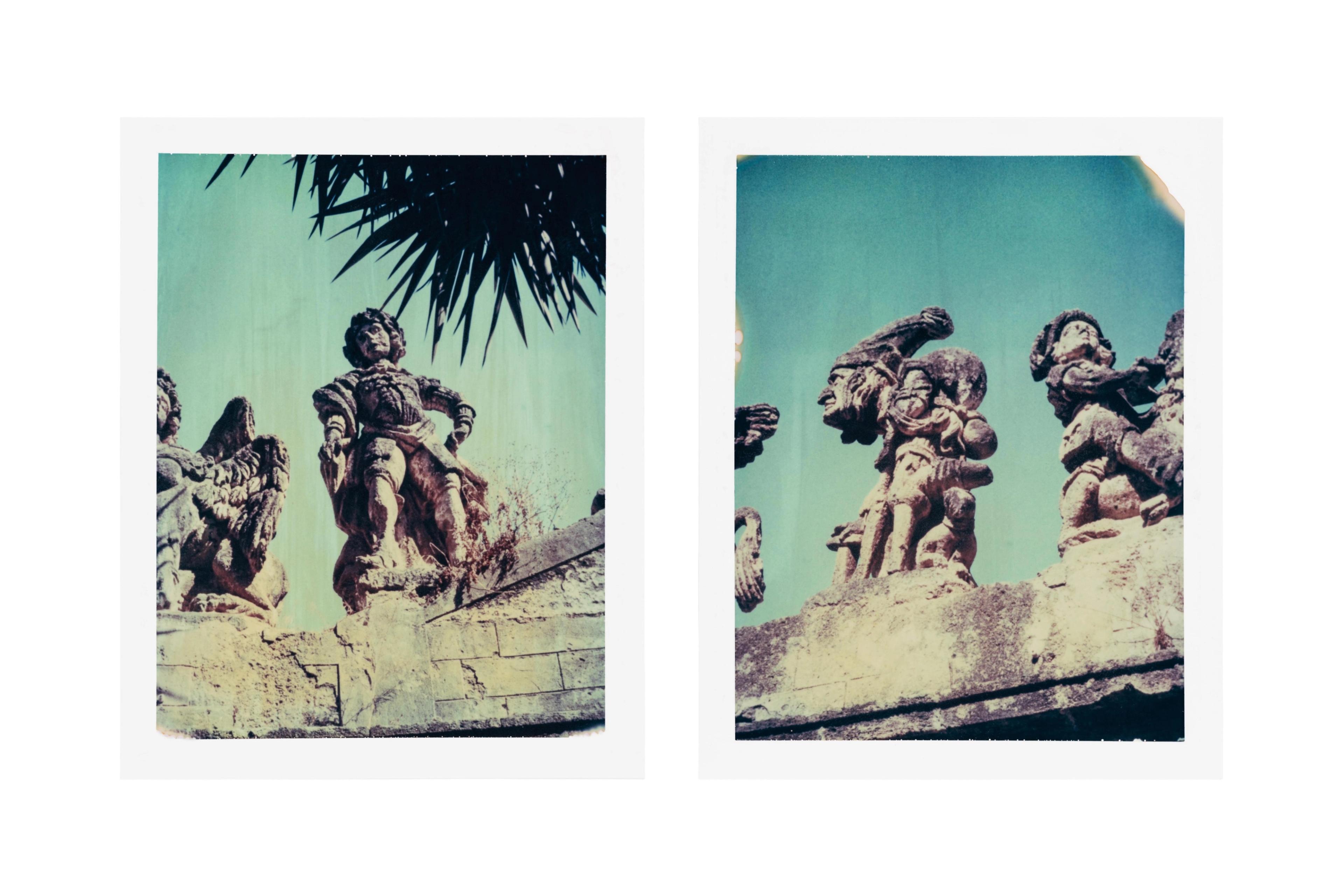
Palermo
Thursday, April 12, 1787
Today we have been shown Prince Torremuzzaʼs cabinet of medals. I was, in a certain degree, loath to go there. I am too little versed in these matters, and a mere curiosity-mongering traveller is thoroughly detested by all true connoisseurs and scholars. But as one must in every case make a beginning, I made myself easy on this head, and have derived both gratification and profit from my visit. What a satisfaction, even cursorily, to glance at the fact that the old world was thickly sown with cities, the smallest of which has bequeathed to us in its precious coins, if not a complete series, yet at least some epochs, of its history of art. Out of these cabinets, there smiles upon us an eternal spring of the blossoms and flowers of art, of a busy life ennobled with high tastes, and of much more besides. Out of these form-endowed pieces of metal, the glory of the Sicilian cities, now obscured, still shines forth fresh before us.
Unfortunately, we in our youth had seen none but family coins, which say nothing, and the coins of the Cæsars, which repeat to satiety the same profile, portraits of rulers who are to be regarded as anything but models of humanity. How sadly had our youth been confined to a shapeless Palestine, and to a shape-perplexing Rome! Sicily and Nova Græcia give me hopes again of a fresh existence.
That on these subjects I should enter into general reflections, is a proof that as yet I do not understand much about them; yet that, with all the rest, will in degrees be improved.
This evening a wish of mine was gratified, and in a very singular fashion. I was standing on the pavement of the principal street, joking at the window with the shopkeeper I formerly mentioned, when suddenly a footman, tall and well-dressed, came up to me, and quickly poked a silver salver before me, on which were several copper coins and a few pieces of silver. As I could not make out what it all meant, I shook my head and shrugged my shoulders, the usual token by which in this country you get rid of those whose address or question you either cannot, or do not wish to, understand.
“What does all this mean?” I asked of my friend the shopkeeper, who, with a very significant mien, and somewhat stealthily, pointed to a lank and haggard gentleman, who, elegantly dressed, was walking with great dignity and indifference through the dung and dirt. Frizzled and powdered, with his hat under his arm, in a silken vest, with his sword by his side, and having a neat shoe ornamented with a jewelled buckle, the old man walked on calmly and sorrowfully. All eyes were directed toward him.
“It is Prince Palagonia,” said the dealer, “who, from time to time, goes through the city collecting money to ransom the slaves in Barbary. It is true, he does not get much by his collection, but the object is kept in memory; and so it often happens that those who, in their lifetime, were backward in giving, leave large legacies at their death. The prince has for many years been at the head of this society, and has done a great deal of good.”
“Instead of wasting so much on the follies of his country-house,” I cried, “he might have spent the same large sum on this object. Then no prince in the world would have accomplished more.”
To this the shopkeeper rejoined: “But is not that the way with us all? We are ready enough to pay for our own follies. Our virtues must look to the purses of others for their support.”
Credits
Johann Wolfgang von Goethe, Voyage en Italie, 1861
Translated into English by Alexander James and William Morrison
Photography by François Halard
© 2023, François Halard
Courtesy the artist